
AI Portfolio & Posture Governance
Establish what your teams are doing with AI. Defend your posture with confidence.
Give leadership a clear, consolidated view of reported AI use, active vendors, and governance gaps—without launching a multi-month enterprise initiative. Capture what is in use and turn it into board-ready slides.
The Core Diagnostic Questions
Leadership is asking about AI. Your teams are already using it.
Answer the four questions every AI posture review comes down to
Stop evaluating abstract frameworks. This workspace is the mechanism that answers these four questions clearly and in one place.
Where is AI actually being used?
Record reported AI tools, workflows, and informal adoption across all eight core business functions before shadow experiments become undocumented dependencies.
Which vendors are involved, and what are their terms?
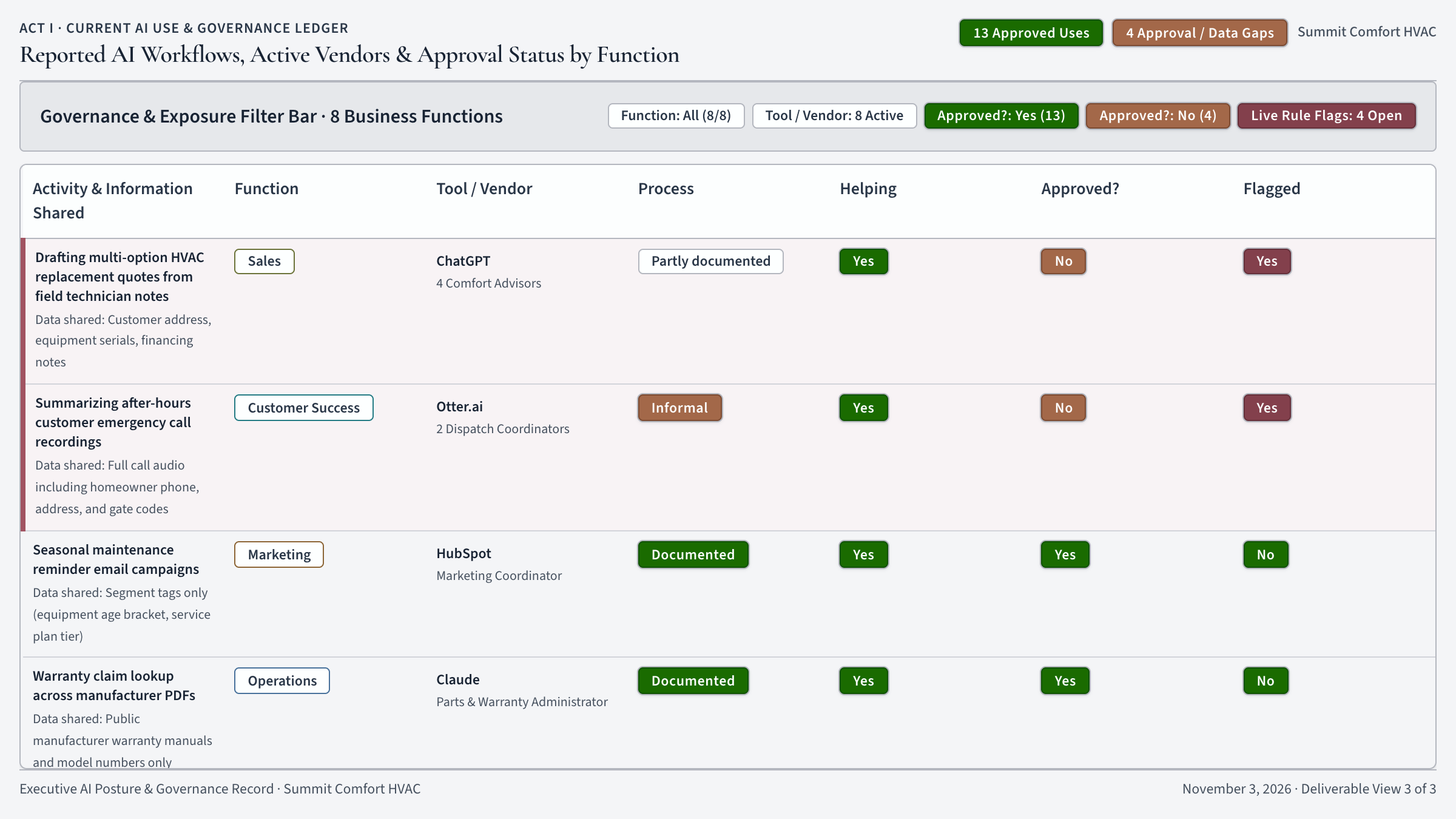
Log the tool or vendor on each AI use, record leadership approval status and what customer, financial, or internal data is shared, and let exposure rules flag gaps that need review.
Where does reported activity differ from company policy?
Compare what teams are reporting against your organization’s stated posture to immediately spot leadership-awareness and governance gaps.
What actually requires immediate action?
Separate routine productivity usage from high-exposure findings that require explicit human-review gates, policy boundaries, or stop conditions right now.
Honest Scope & Realistic Process
Three practical steps from reported reality to board-ready output
No multi-month enterprise rollout and no promises of automatic network discovery. You gather what teams are actually using, the workspace structures the posture gaps, and you present a defensible record.
Step 1: Gather
You collect what your teams are reporting.
Record known AI tools, active vendors, and workflows across your eight core business functions in a structured 15-minute baseline.
Step 2: Structure
The workspace organizes inputs and flags posture gaps.
Compare reported activity against your stated policy, flag uses where leadership approval or data handling is unclear, and separate routine usage from items that need attention.
Step 3: Present
You generate clean, board-ready presentation materials.
Export Executive Summary and Full Report PDFs or present directly from the widescreen slide deck—giving leadership a defensible record without weeks of manual slide-building.
Practical visibility from reported reality—not magical network discovery
Visibility comes from structured information reported by your teams, not invasive endpoint agents or promises of automatic network discovery. That keeps adoption grounded, fast, and safe for operations, risk, and executive leaders alike.
End-to-End Proof & Industry Examples
From messy initial inventory to board-ready leadership output
Whether you are the operational lead assembling the inventory or the executive defending your posture to the board, both roles work from the exact same evidence. Select an industry below to trace the end-to-end arc—or explore all six complete examples and their sample PDFs.
Office staff & techs using AI informally
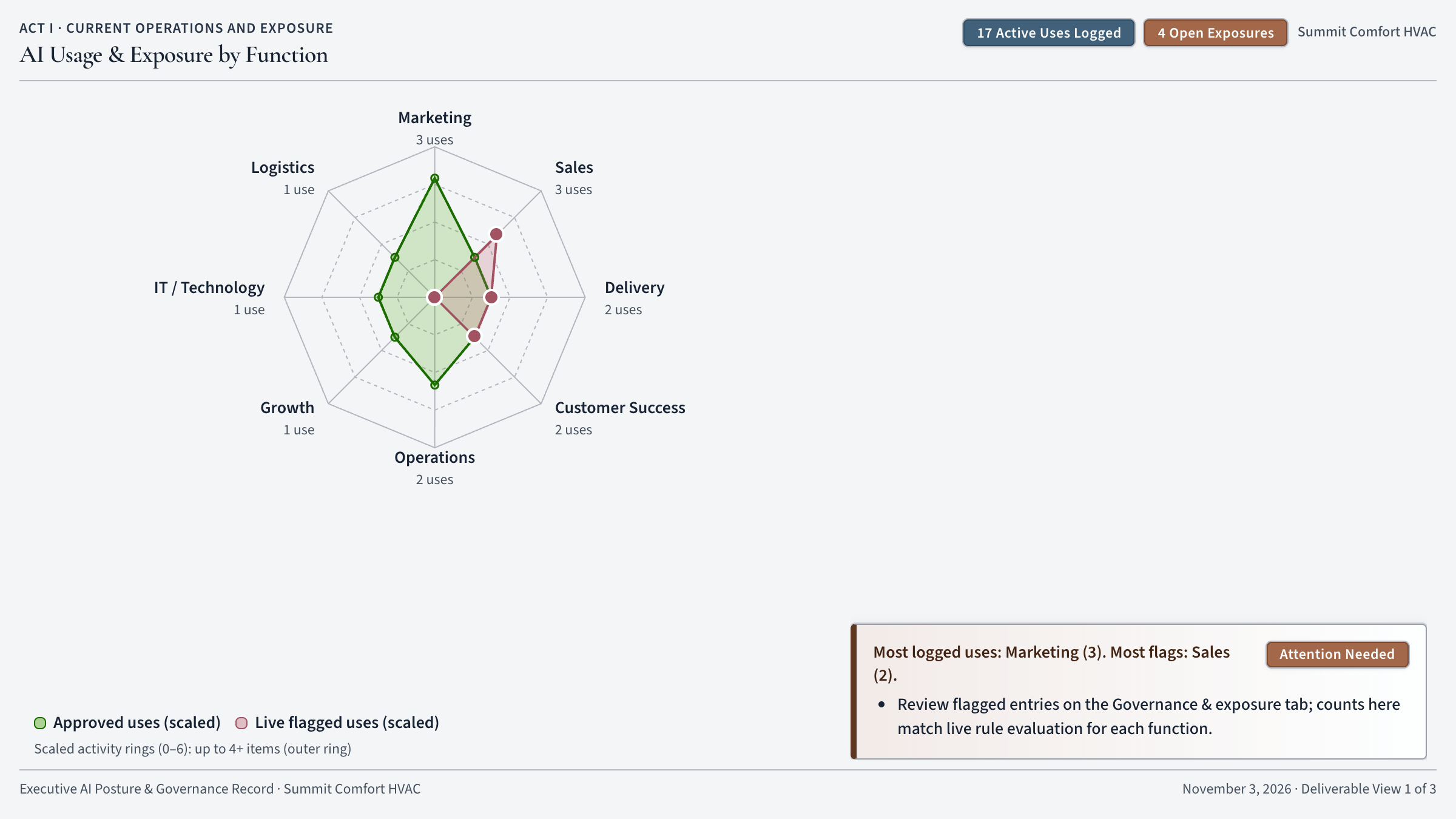
Coordinators paste customer info into ChatGPT for follow-ups, techs look up error codes on personal phones, and replacement quotes take 45–90 minutes by hand.
What shows up in the baseline:
Posture gaps & quoting workflow bounded
The Operations Manager logs all active tools by function, flags the customer-PII exposure, and structures an evaluation for AI-Assisted Replacement Quoting.
How the workspace structures it:
Defensible Q2 trial brief & board readout
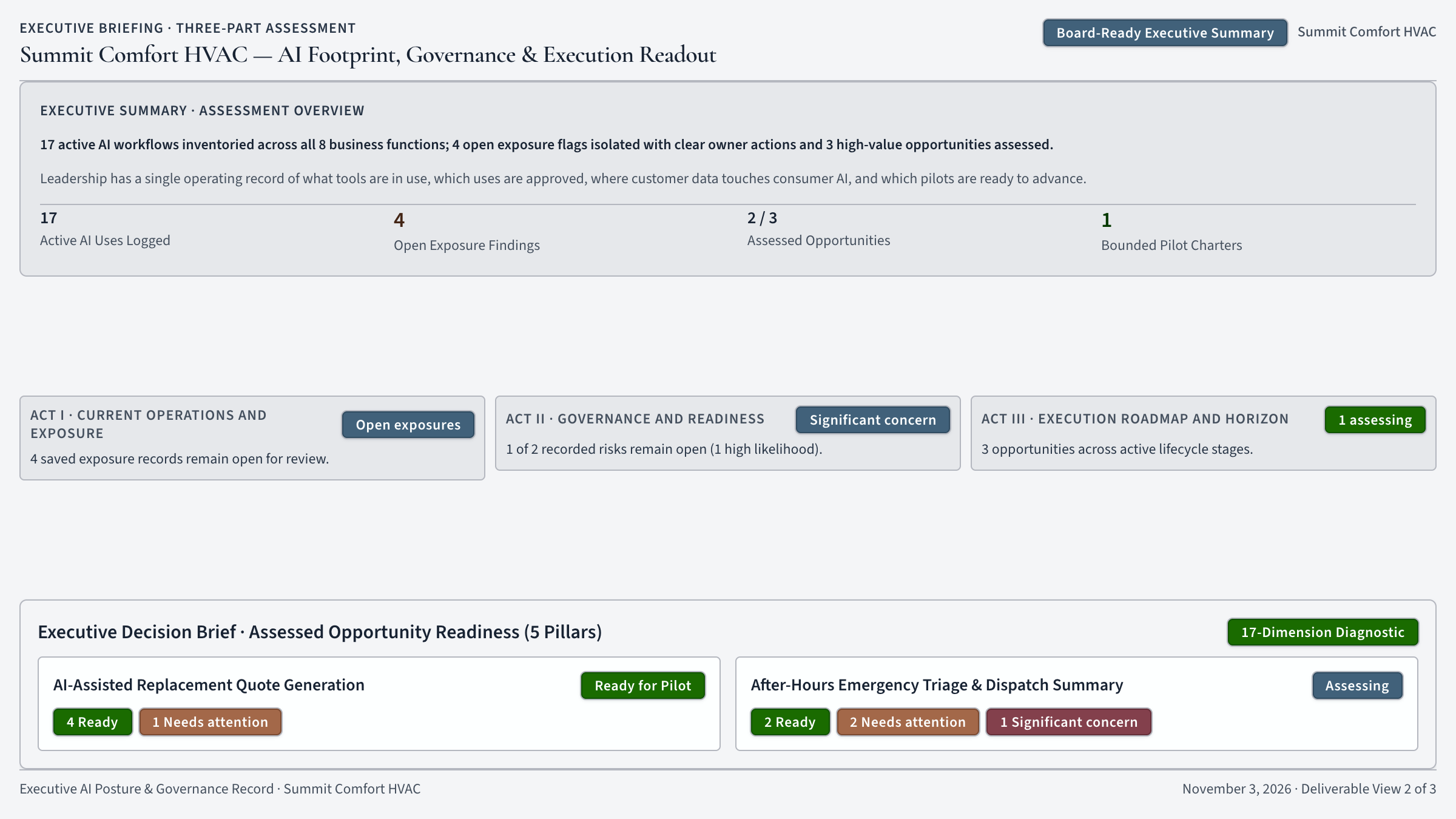
Leadership reviews a single Executive Summary & Full Report: clear boundaries for staff today, plus a bounded two-coordinator quoting pilot with explicit stop conditions.
Boardroom & stakeholder proof:
Regional HVAC Contractor
AI-assisted replacement quotes for a 28-person field service company.
All Six Industry Assessments
Explore every example and download the sample PDF deliverables
AI-assisted replacement quotes for a 28-person field service company.
Example: a 28-person HVAC contractor used the assessment to evaluate replacement quoting, record data-governance gaps, and define human-review gates before considering AI-assisted drafts.
See yourself here if:
Structured visit summaries for a 45-provider primary care group.
Example: a 45-provider clinic used the assessment to evaluate visit-summary drafts, record PHI and BAA constraints, and define the review controls compliance would need to examine.
See yourself here if:
Client intake summaries and contract first drafts for a 22-person regional firm (12 attorneys + 10 paralegals).
Example: a boutique law firm used the assessment to evaluate client-intake summaries, record confidentiality constraints, and separate commercial intake from higher-risk litigation work.
See yourself here if:
AI-assisted product descriptions for a multi-channel outdoor gear brand (2,400+ SKUs).
Example: a 2,400-SKU retailer used the assessment to evaluate catalog-copy drafting, record brand-review gates, and keep merchandisers accountable for every published description.
See yourself here if:
AI-assisted quote worksheet drafts and faster RFQ turnaround for a high-mix, low-volume aerospace subcontractor.
Example: an aerospace subcontractor used the assessment to evaluate RFQ worksheet drafting, record export-control constraints, and keep estimators responsible for final pricing.
See yourself here if:
Governed member support agents and lending ops automation for a ~550-employee cooperative (~$4.5B assets, 45 branches).
Example: a regional credit union used the assessment to evaluate Autonomous Web & Voice Member Support Agents, record PII masking and zero-retention vendor requirements, and keep live agents on authenticated requests.
See yourself here if:
Progressive Depth · The Innovation Horizon
Once you’ve got a handle on what’s in motion, map your pipeline.
After you establish your current AI usage baseline and address immediate vendor or posture gaps, take the natural next step: prioritize future AI initiatives across value, effort, risk, and 17 readiness dimensions on the Innovation Horizon.
Value vs. Effort
Opportunity portfolio
Static preview
Pricing & Deliverable Clarity
Clear deliverables. Zero ambiguity on what is free.
Start with a free account to build your Operational Profile, log AI usage, and view your posture. Upgrade for $250/year when you are ready to run 17-dimension opportunity diagnostics and generate board-ready Executive Summary and Full Report PDFs.
Free Exploration
$0
Establish your baseline inventory, log active AI vendors, and see your organizational posture—completely free, no credit card required.
- Operational Profile setup across 8 core business functions
- AI Usage & active vendor inventory logging
- Organizational AI Posture radar & exposure flags
- Capture AI ideas across all business functions
- Output generated: Printable Operational Profile baseline PDF
Full Assessment
$250 / year
Generate board-ready Executive Summary & Full Report PDFs, presentation-ready slide outputs, and complete 17-dimension opportunity diagnostics.
- Everything in Free Exploration, plus:
- Output generated: Executive Summary PDF & 16:9 presentation slide deck
- Output generated: Comprehensive Full Report PDF with risk & guardrail registers
- Portfolio Prioritization & Innovation Horizon roadmap
- 17-dimension readiness & risk diagnostic per opportunity
- Point-in-time organizational snapshots in History
Questions
Frequently Asked
Leaders accountable for AI investment decisions—CIOs, CTOs, transformation executives, and sponsors who need a defensible portfolio view. Consultants, MSPs, fractional CIOs, and advisors also use the workspace with clients. Industry examples on the site show applicability across organization sizes; they are illustrations, not the only buyer profile.
You do not need a dedicated AI engineering team. The workspace structures business context, operating constraints, and risk into comparable assessments across Process, Data, People, Risk, and Technology—so funding conversations stay grounded in evidence (for example HIPAA boundaries or peak-season operational limits).
Setting up your Operational Profile and capturing your first few ideas takes about 15 minutes. Completing a full assessment — including AI posture, prioritization, a 17-dimension diagnostic, and fields for risks, guardrails, scope, and stop conditions — typically takes 45–90 minutes depending on the complexity of the opportunity.
On the Free Exploration tier ($0), you can configure your Operational Profile, log your AI Usage and vendor inventory, view your Organizational AI Posture radar, and generate a printable Operational Profile baseline PDF. Upgrading to Full Assessment ($250/year) unlocks board-ready Executive Summary PDFs, comprehensive Full Report PDFs, the 16:9 presentation-ready slide deck, and point-in-time organizational snapshots in History. On each industry use-case page you can also download sample PDFs generated from demo account data.
Yes. Setting up your Operational Profile, logging your current AI Usage and active vendors, viewing your Organizational Posture gap analysis, and capturing ideas across all eight business functions are completely free. You only upgrade to the $250/year plan when you want to run formal 17-dimension opportunity assessments and generate Executive Summary and Full Report deliverables.
Absolutely not. As stated in our Terms of Service, we do not sell your personal information or use any Customer Content to train artificial intelligence models.
Yes. If you have a promotion code, you can apply it directly during the Stripe checkout process when upgrading to the full $250/year plan.
Join our newsletter. Unsubscribe anytime.
Get started
Establish your AI posture and leadership record
Give leadership a clear, consolidated view of reported AI use, active vendors, and governance gaps—without launching a multi-month enterprise initiative. Capture what is in use and turn it into board-ready slides.